


When designing a heat-tracing line, how do you decide between self-regulating and constant-wattage heating cables? The two technologies release heat in different ways, and each is better suited to certain applications. Although they’re often presented as alternatives, these two options actually solve quite different design problems, and in many systems, they work side by side, each handling its own task.
At Parma ST, we offer targeted technical consultancy and supply both types of cable, helping you identify which one suits your specific application. In this article, we compare the two solutions, from their working principles and installation constraints through to their typical uses.
How self-regulating heating cables work
Electrical heat tracing is usually carried out using a self-regulating heating cable: a conductor run alongside the pipework that heats it from the outside, without coming into contact with the fluid flowing inside. It consists of two parallel copper bus wires separated by a graphite-loaded polymer compound. This compound is the active element: current passes through it from one wire to the other, meets resistance, and generates heat. In technical datasheets, it’s referred to as a semiconductive polymer matrix.
What makes this cable distinctive is that its heat output adjusts itself automatically according to temperature. In cold conditions, the material contracts, creating more conductive pathways for the current, so power output rises to its maximum; as soon as the pipe reaches the required temperature, the compound expands, closing off those pathways and reducing output almost to zero. This happens independently along every single centimetre of cable, so the same line can run at full power on a section exposed to wind while remaining virtually inactive just a few metres further along, where the insulation is intact. This brings two practical advantages: the cable can be cut to length on site, and it can be overlapped on itself multiple times without creating hot spots.
Constant-wattage cables: parallel and series circuits
Constant-wattage heating cables work on the opposite principle: they carry a fixed current, set at the time of installation, and maintain the same output regardless of conditions, whether the pipe is cold or already up to temperature. A thermostat or limiter monitors the temperature and cuts the power supply once the surface reaches the set value. Under this single commercial label, however, there are two different ways of building the circuit, and the difference lies in the path the electricity takes through the cable.
Zone-parallel circuits
Here, two bus wires carry current along the full length of the cable, while a thin heating wire wound around them generates the heat, connecting alternately to one bus wire and then the other at regular intervals. Each section between two of these connection points forms an independent heating zone – rather like the bulbs on a string of fairy lights, where one going out doesn’t affect the rest. Because of this, the cable can be shortened on site, but only at the boundary between two zones: cutting through the middle of a zone disables it, leaving a “cold tail” (a non-heating section) at the end. On the other hand, this type of cable cannot be overlapped or crossed, and it must be installed so that the heating element doesn’t end up inside a valve or bracket. The 400 V versions can cover long runs without splitting the system across multiple circuits.
Series circuits and mineral insulation
In a series circuit, by contrast, there’s a single heating element running the full length of the line, so a break at any point stops the whole cable from working. The length is calculated at the design stage and manufactured to order – it cannot be shortened or extended on site, so it needs to be specified precisely during planning.
Versions with a plastic sheath can withstand exposure up to 260°C, while mineral-insulated versions, in which the conductor runs inside a metal tube packed with ceramic powder, can withstand 550°C, rising to 700°C in laser-welded variants.
Which one should you choose?
The factors that really drive this decision are few, and they almost always come down to operating temperature, the shape of the line, and how the installation will be carried out on site.
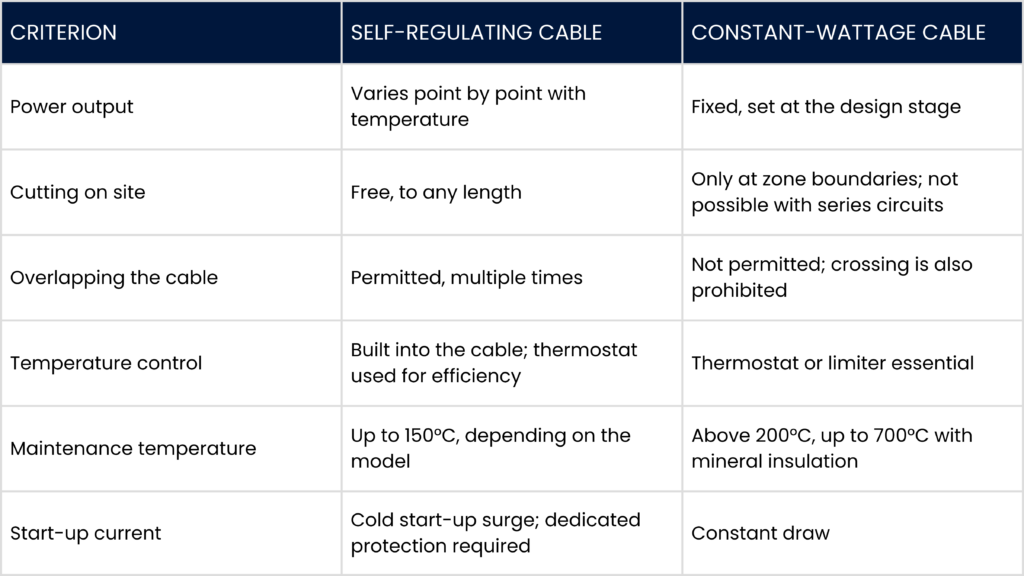
When sizing a system, one important point is often overlooked at the start-up stage: when switched on from cold, a self-regulating cable draws as much power as it can and pulls significantly more current than its rated value. This surge is known as inrush current, and if the upstream protection device doesn’t have the right trip curve, it will trip every time the system starts up. The other family of cables doesn’t suffer from this issue, but has the opposite one: if the thermostat isn’t set accurately, the system keeps generating heat even when it isn’t needed.
Typical applications for self-regulating heating cables
This technology performs best where the route is irregular and temperatures stay moderate. The most common application is freeze protection for pipework, tanks, gutters and ramps, since the circuit only switches on when freezing conditions require it and switches itself off as the temperature rises.
The same principle applies to temperature maintenance on domestic hot water systems, where dedicated versions deliver between 7 and 12 W/m depending on the target temperature, replacing a recirculation loop with a line run directly along the pipe.
The other area where this technology excels is complex geometries. Valves, flanges, pumps and supports require closely spaced runs and often mean doubling back over a section already covered, and being able to overlap the cable without creating hot spots makes it possible to achieve heat tracing that simply couldn’t be done in a straight line.
Systems that require constant-wattage heating cables
Above 150°C, the choice narrows considerably, since self-regulating compounds can no longer cope at these temperatures. Chemical, petrochemical and pharmaceutical plants work with fluids that need to be kept at much higher temperatures, and here constant-wattage cables are the only viable option. The same applies to bitumen processing plants, where the product needs to stay fluid inside machinery and pipework that reach temperatures no plastic could withstand.
The other factor worth considering is length. On very long runs, such as lines running the length of entire plant sections, a series circuit can supply from a single point what would otherwise require multiple panels and protective devices, considerably simplifying the upstream electrical installation.
Ultimately, the decision comes down to a handful of factors: process and exposure temperatures, the layout and length of the line, the area classification, the thickness of the insulation, and the power available at the panel.
On the projects we manage, it’s common for both technologies to be used together, with self-regulating cable on freeze-protection circuits and zone-parallel cable on process lines. We check every branch using the manufacturer’s calculation software before installation. As an Official Authorised Distributor of RAYCHEM products, we support the project from initial assessment through to final testing.
Want to find out which solution suits the operating conditions of your system? Get in touch, and our technicians will review your requirements with you, right through to circuit sizing.